
BLOG
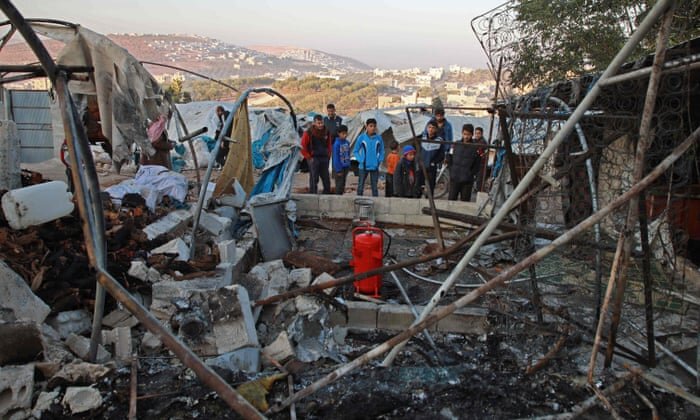
Syrian regime targets hospital and refugee camp, killing at least 22
“At least 22 civilians have died after the Syrian government shelled a displacement camp and hospital, rescue workers and residents have said, as Bashar al-Assad continues to pound the last pocket of opposition-held territory in the country."

Source: The Guardian By Bethan McKernan Middle East correspondent. Thu 21 Nov 2019 16.12 GMT.
At least 22 civilians have died after the Syrian government shelled a displacement camp and hospital, rescue workers and residents have said, as Bashar al-Assad continues to pound the last pocket of opposition-held territory in the country.
The camp hosting 7,000 people near the village of Qah in Idlib province was hit by a ground-to-ground missile on Wednesday night carrying illegal cluster-bomb submunitions. The attack killed at least 16 people, injured dozens more and started fires which blazed through the flimsy tents.
Another rocket damaged the Qah maternity hospital 30 metres away from the camp, killing two women and six children and injuring four medical workers, the Syrian American Medical Society (Sams) said in a statement. All patients were evacuated and the facility has now been abandoned.
Earlier on Wednesday, Russian military aircraft targeted the town of Maaret al-Numan in southern Idlib, killing six.
“All the children started crying, people started running towards the olive orchards trying to escape,” said Zaher Ghara’a, a 42-year-old resident who has lived in the camp for six years.
“I saw tents burning then heard the White Helmets [Syrian civil defence service], ambulances and fire engines approaching. My cousin’s van was damaged but the tyres were still good so he helped transporting people to hospitals. It was covered in blood by the time he finished.”
It took two hours to extinguish the fires and evacuate the wounded, said Ibrahim Abu al-Laith, a White Helmets spokesman, adding that the area was still off-limits on Thursday due to unexploded ordnance.
Bombardment by Assad’s forces and his Russian allies has killed more than 1,300 people and sent almost 1 million fleeing to the Turkish border since an attack on Idlib and the surrounding countryside began in April.
Wednesday’s attack on Qah, however, was much further north than the campaign’s parameters to date, sparking fears that the already ferocious assault could escalate.
Aid agencies have repeatedly warned that attacking Idlib puts the lives of 3 million civilians in danger and could trigger the worst humanitarian disaster of the almost nine-year war to date. Originally home to about 1 million people, the province’s population has been swollen with civilians displaced by fighting elsewhere in the country.
The incident at the Qah clinic marks the 65th attack on 47 health facilities in the area since April.
The facility was supposedly on a UN no-strike list shared with parties active in Syrian airspace, but Damascus and Moscow have been repeatedly accused of using the GPS coordinates to deliberately target civilian infrastructure.
“I think the regime targeted this camp on purpose,” said Dr Muheeb Qadour, the director of nearby Atmeh hospital, who rushed to the scene to help.
“The hospital is just for women and children and it’s near the border, away from the frontline. There are no military headquarters in this area.”
A ceasefire deal brokered by Russia and Turkey in September last year was supposed to save Idlib from the impending regime attack, but it unravelled after the hardline Hayat Tahrir al-Sham (HTS) wrested control of the area from more moderate rebel groups in January. A Russian-announced unilateral ceasefire in August was also never fully implemented.
Many in Idlib have expressed anger at Turkey, which backs Syria’s opposition groups, for abandoning them to focus on Ankara’s new campaign against western-backed Kurdish forces in Syria’s north-east, where it is relying on Russia to act as a mediator.
“Turkey is the guarantor of the alleged ceasefire but the regime and Russia haven’t abided by the agreement,” said Ghara’a. “It’s just a weak excuse, a trick.”
Additonal reporting by Hussein Akkosh
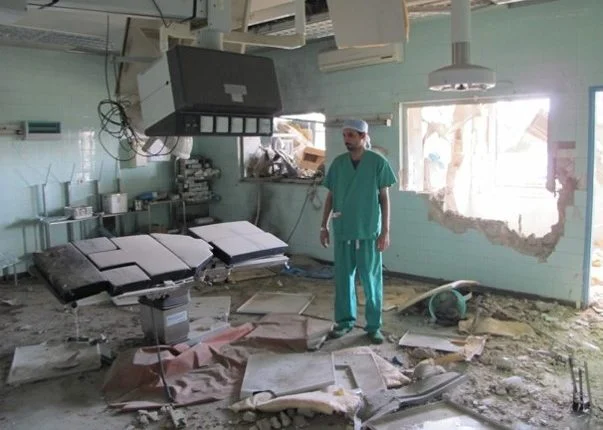
PHYSICIANS FOR HUMAN RIGHTS: STAND WITH PHR AGAINST INJUSTICE
Physicians for Human Rights is a US-based not-for-profit human rights NGO that uses medicine and science to document and advocate against mass atrocities and severe human rights violations around the world, with a focus on attacks on healthcare in Syria.
Action For Sama are thrilled to partner with Physicians for Human Rights as the organisation documents attacks on healthcare facilities and the killing of medical personnel in Syria. Using evidence rooted in science as a critical tool to establish a fact-based record of human rights abuses and make human rights violators accountable for their crimes.
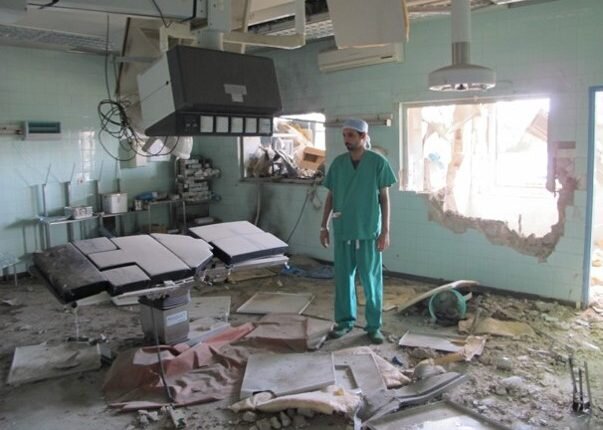
Photo credit: Physicians for Human Rights
By calling attention to these crimes and securing evidence to hold perpetrators accountable in future national or international justice processes, Physicians for Human Rights are an integral part of how Action For Sama plans to call for justice and accountability for the Syrian people.
For example, Physicians for Human Rights have researched, documented, and mapped widespread and systematic attacks on medical infrastructure in Syria since March 2011, amounting to 583 attacks on at least 350 separate facilities from March 2011 through August 2019. As you can also see on our About Syria page (link), their interactive map of Syria provides location information and details on attacks which Physicians for Human Rights was able to independently corroborate – 90 percent of which have been committed by the Syrian government and its Russian allies.
We at Action For Sama look forward to sharing more information and fact-based evidence from our partners Physicians for Human Rights and we urge you to follow them and spread awareness of their incredible work by sharing suggested posts below:
Tweet:
@ActionForSama is proud to partner with @P4HR to #StopBombingHospitals. @P4HR documents and advocates against atrocities such as current bombings in #Syria. Find out more about their crucial work here https://phr.org/ #ForSama #ActionForSama
Facebook: Action For Sama and Physicians for Human Rights
@ActionForSama is proud to partner with @physiciansforhumanrights in #ActionForSama’s campaign to #StopBombingHospitals. @physiciansforhumanrights uses science and medicine to document and advocate against human rights atrocities such as the current bombings of civilians and healthcare workers in #Syria. Find out more about @physiciansforhumanrights crucial work in Syria here https://phr.org/ #ForSama #ActionForSama
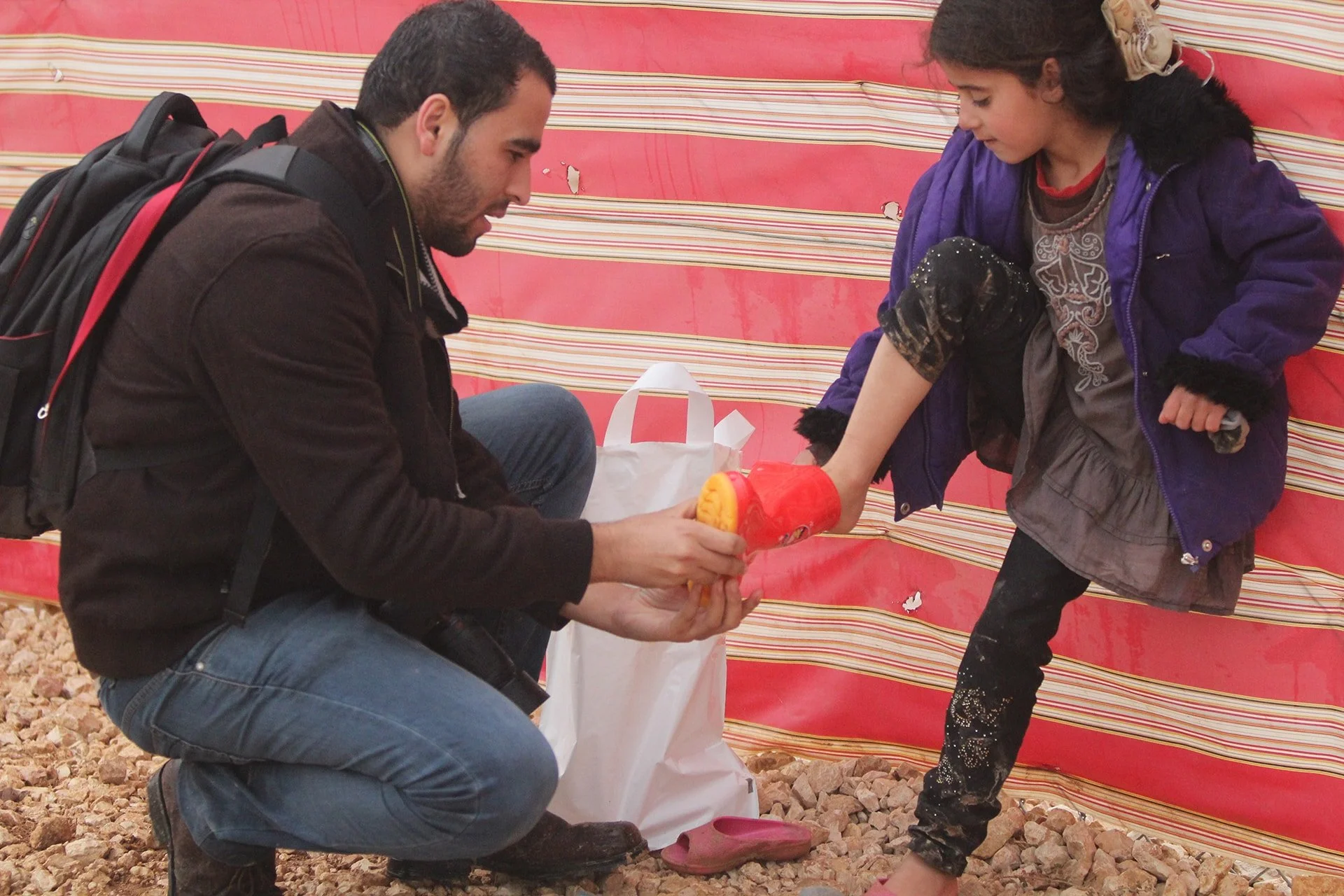
MOLHAM VOLUNTEERING TEAM: INSPIRE YOUR HUMANITY
Founded in 2012, the Molham Volunteering Team is a nonprofit organisation registered in France, Turkey, Jordan, Sweden and Canada. The organisation’s aim is to provide aid to internally displaced persons in Syria and to Syrian refugees living in camps of neighbouring countries.
The Team is named in honour of Molham Traifi. An exceptional young man from the city of Jableh, he was among the first voices calling for freedom and defying the Syrian regime that detained and tortured him for almost a month. Upon his release in June 2011, he spent a few months with his family in Saudi Arabia, but as he could not not bear to leave his country behind, he returned to Syria, risking his life to continue serving others. Molham was killed in government shelling on the city of Salma, Lattakia on June 10, 2012. Determined to honor him and carry his legacy, a group of his friends founded “Molham Volunteering Team” on October 26, 2012.

Photo credit: Molham Vounteering Team
Since 2012, the team has grown and now consists of 180 volunteers from all around the world working together to deliver basic necessities to Syrians in need. The Molham Volunteering Team launches emergency campaigns to provide humanitarian relief and address the needs of civilians in distressed areas and does so in an independent way, free of any political orientation or partisanship.
Action For Sama has great respect for the expanding role that Molham Volunteering Team has taken on within the field of humanitarian aid. For example, Molham Volunteering Team is currently providing food and core relief items to displaced families in the Idlib region, which is suffering from the Syrian government’s escalated attacks since April 2019.
If you would like to help Action For Sama share awareness of the amazing work that Molham Volunteering Team are doing, we have included some social media examples for you to show your support:
TWEET:
Join @ActionForSama in acknowledging @molhamteam‘s amazing humanitarian work to help people in need in #Syria. #ActionForSama #ForSama #MolhamTeam #StopBombingHospitals
FACEBOOK: Action For Sama
Join @ActionForSama in acknowledging the amazing humanitarian work of @molhamteam to help the people of Syria. Learn more about #MolhamTeam’s humanitarian work to help provide aid to Syrian civilians.

US Broadcast Premiere FRONTLINE PBS Tues Nov 19
For Sama will be broadcast on FRONTLINE PBS on Tues Nov 19, 9pm CT / 10pm ET


How New York Times Reporters Proved Russia Bombed Syrian Hospitals

Source: The New York Times, By Christiaan Triebert, Evan Hill, Malachy Browne, Whitney Hurst and Dmitriy Khavin. 13th Oct 2019, updated 14th Nov 2019.
The Times obtained thousands of air force recordings, which reveal for the first time that Russia repeatedly bombed hospitals in Syria.CreditCredit..Macro Media Center
The New York Times recreated a day of airstrikes using video evidence, flight logs, witness reports and thousands of previously unheard Russian Air Force communications. See the full report here.
Times Insider explains who we are and what we do, and delivers behind-the-scenes insights into how our journalism comes together.
One of the hospitals in this article, Kafr Nabl, appears to have been bombed by Russia again, on Nov. 6. This Times Insider explains how we investigated the bombing of it and another Syrian hospital in May.
“Srabotal,” the Russian pilot said.
The Russian phrase, which directly translates as “it’s worked,” was confirmation that he had released his weapon on a target in Syria: Nabad al Hayat Surgical Hospital near the town of Haas in Idlib Province.
Beginning in 2017, The Times’s Visual Investigations team has tracked the repeated bombing of hospitals in Syria, an apparent strategy of the Syrian military and Russia, its ally. More than 50 health care facilities have been attacked since the end of April in an offensive to reclaim Idlib Province from militants opposed to Syria’s president, Bashar al-Assad, according to the United Nations’ Office of the High Commissioner for Human Rights.
[Read and see our investigation into Russia’s bombing of Syrian hospitals.]
Our team combines traditional reporting with advanced digital forensics to understand major events in conflicts that Times reporters can’t access on the ground, like a chemical attack in Syria or an American airstrike in Afghanistan.
Finding visual evidence of Syrian hospitals that were badly damaged was not hard. We collected hundreds of photos and videos from Facebook groups and Telegram channels, two places on social media where Syrian journalists and citizens had shared hours of footage. Along with medical and relief organizations, users on those platforms sent us even more documentation, including internal reports and unpublished videos.
While Russia has long been suspected of being behind these hospital bombings, direct evidence of its involvement was difficult to find, and Russian officials have denied responsibility.
During our investigation, we obtained tens of thousands of previously unpublished audio recordings between Russian Air Force pilots and ground control officers in Syria. We also obtained months of flight data logged by a network of Syrian observers who have been tracking warplanes to warn civilians of impending airstrikes. The flight observations came with the time, location and general type of each aircraft spotted.
Could these communications, each only a few seconds long and riddled with seemingly indecipherable military jargon and code words, be direct evidence of Russia’s violating one of the oldest rules of war?
Times reporters spent weeks translating and deciphering code words to understand how Russian pilots carry out airstrikes in Syria. This spreadsheet shows part of the communication between one pilot, identified as “48,” and the ground controller, “Fuse,” during a strike on Nabad al Hayat Surgical Hospital.Credit...The New York Times
We needed to verify and match the Russian communications and flight logs with the other airstrike information we had gotten, including satellite images and doctors’ witness statements. Deciphering the communications and finding the precise time and location of each hospital strike proved to be the key.
We had months of data but decided to focus on May 5 and 6, when four hospitals had been bombed. Each was on a United Nations-sponsored “deconfliction list” meant to spare it from attack, according to the World Health Organization.
We eventually saw patterns in the data. The clearer the picture got, the more damning it became for Russia.
We then organized and merged all of this information into a spreadsheet database. A data analyst in our Graphics department, Quoctrung Bui, designed a tool that allowed us to filter and search thousands of data points by time and place.
For each airstrike, we examined the evidence recorded at the time of the attack: Were Russian Air Force aircraft in the air? Were they spotted near hospitals? What were they talking about on the intercepted audio?
In the case of Kafr Nabl Surgical Hospital, which had been bombed repeatedly and restored with help from the W.H.O. in March, local news coverage and incident reports placed the time of the attack at about 5:30 p.m. on May 5.
Witnesses are often central to estimating timing, so we spoke to a doctor who was working at Kafr Nabl when it was hit. He said the hospital was first struck at 5:30 p.m., with three more airstrikes following five minutes apart.
Local media activists started filming after the first strike. Four of them caught the next strike on video. Did they all show the same airstrike? Or multiple ones — perhaps even four, as the doctor described?
To find out, we needed to know whether the videos were filmed in Kafr Nabl. Using Google Earth, we labeled landmarks, like a minaret and a water tower, and kept track of the nearby hills and mountain ridge.
Times reporters used Google Earth Pro to plot airstrikes, hospitals and visual evidence on a map. This is a view of the town of Kafr Nabl in Syria. In the foreground is Kafr Nabl Surgical Hospital, and in the top right corner, faintly visible, is Nabad al-Hayat Surgical Hospital. Both were bombed by the Russian Air Force, a Times investigation found.Credit...Google Earth Pro
This practice, known as geolocation, can determine the exact site of a photo or video by using landmarks and geographical features and corroborating them with satellite imagery. We managed to geolocate all of the videos and determined that the explosions all happened at Kafr Nabl Surgical Hospital.
We then analyzed the explosions and smoke patterns. After going through each video frame by frame and lining up several videos next to each other, we realized we had footage of three different strikes from multiple angles.
Videos filmed by media activists in Syria capture the moment of an airstrike on Kafr Nabl Surgical Hospital on May 5, 2019. The World Health Organization-supported hospital was bombed four times in eighteen minutes.Credit
An analysis of the shadows in the video allowed us to estimate the times of the strikes. But to get the exact time, we asked local journalists and news agencies to send their footage so we could use the files’ metadata to see when each strike hit the hospital, down to the second: 5:36:12, 5:41:14 and 5:49:17 p.m.
We knew that at least three, possibly four, airstrikes had hit the hospital. But we didn’t have a culprit. The flight logs and videos of the aircraft above Kafr Nabl that day didn’t have the key either. Both Russian and Syrian air forces had been active. It was a perfectly ambiguous situation: We didn’t know who bombed the hospital, but it must have been one of the two.
But the Russian Air Force communications provided the clearest evidence of Russia’s responsibility because we had the exact time of the explosions from the video metadata. A Russian pilot released four weapons at those very times.
The pilot, who identifies himself as “72,” says “Srabotal” at 5:30 p.m. He repeats that five minutes later, at 5:35 p.m. — and at 5:40 and 5:48 p.m. Four weapon releases in all, each about five minutes apart and about some 40 seconds before the time of impact we had calculated from video metadata.
Because the hospital was dug deep under its original building after repeated bombings, only one person was killed. Many others were injured.
We saw three other instances when the Russian Air Force “worked” on hospitals over a period of 12 hours in early May. The evidence was clear in each case. Less than a day of air activity in a four-year-old Russian air war paints a damning picture for a permanent member of the United Nations Security Council.
Reporting was contributed by Quoctrung Bui, John Ismay and Haley Willis.
Graphics by Dave Horn. Video credits: Halab Today TV, Hadi Alabdallah, Euphrates Post (via Facebook) and Syria Call.
Follow the @ReaderCenter on Twitter for more coverage highlighting your perspectives and experiences and for insight into how we work.
Christiaan Triebert is a journalist on the Visual Investigations team, which combines traditional reporting with advanced digital forensics. @trbrtc
Evan Hill is a journalist on the Visual Investigations team, which combines traditional reporting with advanced digital forensics. @evanchill
Malachy Browne is a senior story producer on the Visual Investigations team, which practices a new form of explanatory and accountability journalism combining traditional reporting with advanced digital forensics. @malachybrowne

Audience held “Stop bombing hospitals” signs after For Sama screenings
Source: Esperanza Productions / AudioBoom, 17th Sep, 2019
Audience hold up posters STOP BOMBING HOSPITALS following discussion after screening of Waad al-Kateab’s compelling FOR SAMA in the IFI’s Cinema 1 (Sept.14, 2019). Filmmaker Anne Daly co-producer with Ronan Tynan of the award winning SYRIA – THE IMPOSSIBLE REVOLUTION captured the very strong feelings in this audio report about the need to do something about Idlib – the next Aleppo but on a frighteningly bigger scale with three million including one million children already in the firing line.
Ronan Tynan who chaired the event wrote this blog post:
I asked members of the audience to hold up signs reading STOP BOMBING HOSPITALS in Cinema 1 at the IFI after the discussion I chaired following the screening of FOR SAMA. Waad al-Kateab who made that compelling film had apparently done the same at a recent screening and it actually seemed the only authentic and valid protest one could make after watching her, Dr Hamza her husband and their baby daughter Sama being bombed relentlessly in a hospital by the Russian airforce and the Assad regime’s forces.
One expression of frustration from Waad on the sound track of her documentary ‘For Sama’ reminded me why Anne Daly and I made our film ‘Syria – The Impossible Revolution’. She mentioned the hundreds of thousands who would have seen her film reports on Channel 4 from Aleppo and wondered why they did not seem to make any difference. Meanwhile Anne and I got fed up with people telling us they did not understand what is going on in Syria so we made what we saw as a very ambitious historical style documentary about the rise of the Assad family, the peaceful uprising in 2011 and struggle for freedom up to the fall of Aleppo to help people understand what is going. ‘For Sama’ on the other hand allowed us to experience what it felt like day after day to be bombed while trying to save lives. Remarkable they survived considering before the fall of Aleppo their hospitals was the last out of nine still functioning!
For Sama is so authentic it will qualify as prima facie evidence of crimes against humanity when eventually Assad and his henchmen face trial, though it may take a long time. A fact brought how repeatedly to us at the moment making a new documentary on that very theme: BRINGING ASSAD TO JUSTICE.
For us however what was truly traumatic about watching FOR SAMA was knowing the Russian airforce and the Syrian regime and its various militias with Iran are subjecting well over three million civilians in idlib to the same terror. Over a thousand civilians have been murdered recently including over three hundred children. Despite talk of cease fires the slaughter and the relentless bombing of hospitals continues.
Hopefully FOR SAMA will make more people wake up and feel the pain and terror facing defenceless families in Idlib. We know what is going on. We have no defence because silence equals complicity.
And if you want to find out more of the context please check out our ‘Syria – The Impossible Revolution’.
Ronan L Tynan is Director of the multi award winning ‘Syrian – The Impossible Revolution’ and co-founder with Anne Daly of Esperanza Productions:
Web site: http://www.esperanza.ie
Twitter: @RonanLTynan

Affecting chronicle of life in war-torn Aleppo
Source: The Guardian, Mark Kermode, Observer film critic, Sun 15 Sep 2019 08.00 BST
There is a scene in the middle of this powerful, harrowing and deeply human documentary about life under siege in Aleppo, Syria, that perfectly encapsulates its mixture of horror and hope. In the terrible aftermath of yet another airstrike, a pregnant woman with broken limbs and shrapnel in her belly is brought into a makeshift theatre in al-Quds hospital. An emergency caesarean brings her critically unresponsive child into this world of carnage – a terrible, pitiable sight, made all the more unwatchable by the certainty that nothing so vulnerable could possibly survive such violence. Syrian citizen-journalist and mother Waad al-Kateab, whose frontline footage was seen in Channel 4 News’s Inside Aleppo reports, keeps filming, determined to bring such daily atrocities to the attention of the world. And then, as the spectacle seems too cruel to endure, a miracle occurs, offering a gasping glimpse of redemption amid this unfolding hell.
With footage as raw and dramatic as this, it’s a credit to composer Nainita Desai that her score remains restrained and understated throughout, emphasising subtler themes of endurance and empathy, while gesturing gently toward the possibility of hope – of love – even in the midst of tragedy.
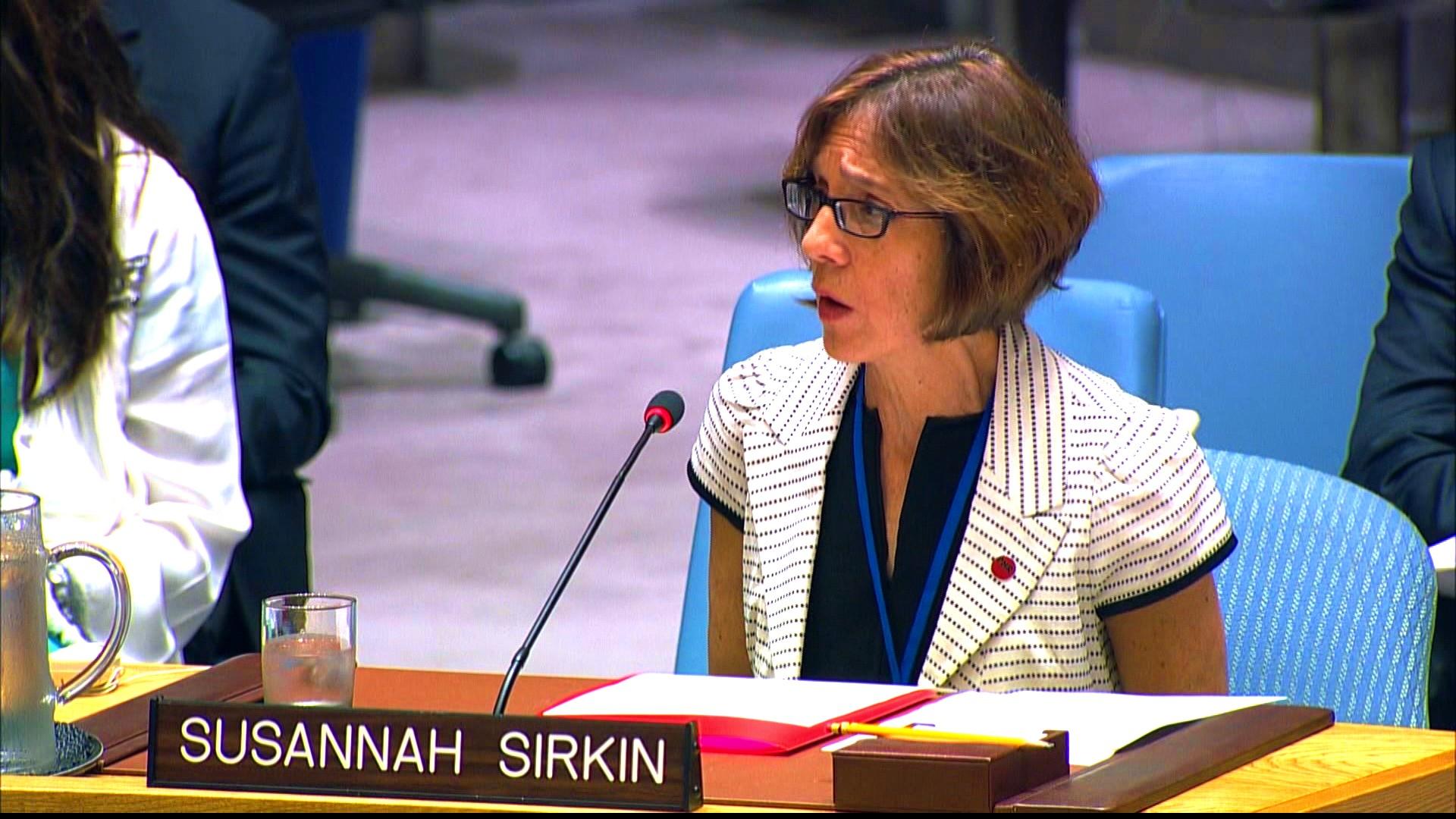
Syria’s hospitals bombed: UN Security Council calls for inquiry

Source: Aljazeera English, 30th July, 2019
How the UN failed to save Syria’s hospitals

Source: Aljumhuriya, 24th July, 2019
A Syrian doctor says the UN’s plan to stop attacks on hospitals in Syria has failed. If it can’t be fixed, it should be abandoned.
In northwest Syria, a colleague of mine named Morhaf works as a doctor in a health facility supported by our organization, the Syrian American Medical Society (SAMS), which provides medical care in some of the most dangerous regions of the Syrian conflict. In my capacity as head of advocacy in Turkey, I recently asked Dr. Morhaf to conduct an interview with a large human rights NGO to talk about the ongoing attacks on health centers in his area by the Syrian regime and its Russian ally. His response was highly telling. “What did the hundreds of interviews we gave about Aleppo with human rights NGOs and investigation bodies change? Did we stop attacks on health centers?” he asked me.
We did not, is the answer. Since the outbreak of the Syrian conflict in 2011, more than 570 attacks on health centers have been reported. Over 800 health workers have been killed in these attacks.
Moving underground
Forced to fend for themselves, local medical staff inside Syria have proven strikingly creative in finding alternative methods of protecting their facilities. They have built hospitals underground, or used basements or even caves as makeshift health centers. While these don’t always meet international standards for medical facilities, they’ve succeeded nonetheless in decreasing the risks of attack. So convinced were we, as the regional staff, of the benefits of these underground hospitals that we began trying to raise funds from donors for their construction. Though the local staff went along with this out of necessity, it was never their first choice; they were always clear that the goal ought to be protection and accountability.
Failed “deconfliction”
To that end, we began considering participation in a UN program intended to reduce risks to medical practitioners in war zones. Under this “humanitarian deconfliction mechanism,” as it’s known, the geographic coordinates of health centers (as well as other vital civilian infrastructure, such as schools) are shared with the UN, which in turn passes them on to the warring parties, in order that they—theoretically—avoid targeting the locations in question. Given the systematic bombing of health facilities in Syria, it was always going to be difficult to convince our colleagues on the ground that this mechanism might work, but we eventually reached the stage of having no alternative options.
Sure enough, in 2018, there were six attacks on “deconflicted” health facilities, while in 2019, fourteen of the thirty-eight attacks on medical centers between 26 April and 22 July alone struck deconflicted sites. There have been no consequences for the perpetrators, who are known to all parties, raising inevitable questions about the value of the mechanism.
No will, no way
What is the reason for so abject a failure? It’s certainly not a lack of information. There are at least two full pages on attacks on medical facilities in each one of the reports put out by the UN Independent International Commission of Inquiry on Syria, attributing responsibility for the majority of attacks to the Syrian regime. The World Health Organization’s website hosts a dedicated page documenting attacks, which demonstrates that they are far more systematic in Syria than in other conflict zones. Leading human rights NGOs such as Human Rights Watch, Physicians for Human Rights, and many others have similarly documented systematic attacks on health facilities in Syria.
There is more than enough information out there; the problem is there is still no will to stop the perpetrators. Instead, we see only cosmetic solutions providing ostensible success stories for state donors to convince their domestic parliaments they are doing good.
Are there alternatives?
In spite of all the above, I do believe that, even within the deeply flawed institutions of the international community, with all their bureaucracy, power imbalances, and political dynamics, there are still things that can be done for Syria. The UN could take several steps to stop these attacks. Its Commission of Inquiry (COI) should be much quicker in investigating attacks on health centers—to date, all its reports have come out months after the crimes have been committed, making them useless during the time periods that offensives are actually underway. UNOCHA should provide its “deconfliction” data to both the COI and the International Impartial and Independent Mechanism in Syria (IIIM). Similarly, both UNOCHA and the COI should be given access to the UN’s Operational Satellite Applications Programme (UNOSAT), in order to compare satellite images before and after reported attacks. The IIIM should immediately launch investigations into these attacks, and work with war crimes prosecutors around the world to hold perpetrators to account.
Dr. Mohamad Katoub is a doctor formerly based in Damascus’ Eastern Ghouta suburb. He is the head of advocacy in Turkey for the Syrian American Medical Society (SAMS). He tweets @MhdKatoub.